
Sioux County's Rolling Police Blotter
The Sioux County Sheriff's Office posts its official Arrest Press Log as a PDF that regenerates with each release. One version stretched nine pages. It spanned August 10 through September 8, 2026, and carried a 6:00 p.m. report time. Earlier copies showed the same format over different dates. Treat the file as a moving blotter. It is not a month-by-month archive. The printed range helps you catch arrest activity across weekends and several reporting days. No posting schedule promises weekend surges or holiday catch-ups. The timestamp marks when the document was generated, not when each booking was entered or when the public file changed.
Released people can stay listed here. The current roster drops them once custody ends. That makes the Sioux County blotter a history of recent arrests rather than a live custody check.
Read Sioux County Arrest Entries
Start with the date range printed inside the PDF. Entries can stretch well past a week. An arrest booked days earlier may sit beside a newer release field, so order means little. The agency label matters most, since one county file consolidates the Sheriff's Office with several municipal departments.
- Open the official press log and write down its beginning date, through-date, report time, and retrieval date.
- Locate the person by name, then compare age, address or city, sex, and arrest date. A name alone is not a safe match.
- Read the agency and location columns together. They separate a city-police arrest from a Sheriff's Office arrest while showing the shared county booking route.
- Record the incident number, warrant number, and Iowa Code line when present. These references help the agency or clerk locate the underlying file.
- Treat bond and release fields as custody events. Use Iowa Courts Online for filed charges and the eventual disposition.
The Arrests Last 24 Hours page filters this wider report by date and checks the roster too. The blotter serves another need. It preserves arrest context across many reporting days and agencies.
Sioux County Blotter Record Fields
The blotter holds far more detail than the inmate roster does. Each Sioux County entry links the arrest, the booking, and the custody result. Together those fields sketch the full booking picture.
| Blotter field | Meaning and limit |
|---|---|
| Name, age, address/city, sex | Identity clues reported in the booking entry; verify common-name matches. |
| Arrest date | The date attached to the event, distinct from the PDF print time. |
| Arresting agency and location | The department responsible and the reported place of arrest. |
| Iowa Code and charge description | The charge recorded at booking, subject to later court action. |
| Incident and warrant numbers | Official references shown when applicable. |
| Bond amount and type | Custody terms, not a guilt finding. |
| Release date and reason | How the jail custody event ended; not the case disposition. |
| Booking photo | No routine booking-photo field or image was observed in the current log. |
Release labels in the Sioux County log include bondsman, cash bond posted, unsecured bond, court order, and personal recognizance. Federal wording appears too. Personal recognizance means release on a promise to appear rather than posted cash. A "pled guilty" label still covers only one charge. Read it narrowly. For case follow-through, the Iowa Courts Online search is the official tool. Match it by county first.
Weekend Sioux County Arrest Reporting
A multi-day window helps after weekends. Several arrest dates sit in one file. The Sheriff publishes no special weekend or holiday upload rule. A Monday download is not automatically a complete weekend total. Intake, report generation, and posting are separate steps. Check every relevant arrest date. Note the report's through-time. Then compare the roster. Released people linger in the blotter until the rolling window advances past their booking. The roster can still hold someone booked before the weekend. These gaps are normal, not errors.
City labels give the county report extra value. The log mixes Sioux Center PD, Orange City PD, Rock Valley PD, and Hawarden PD with the Sheriff's Office and other agencies. So it is not a deputy-only arrest list.
Older Sioux County Arrest Records
The Sheriff posts no fixed retention period for the roster or the press-log PDF. Once a date leaves the rolling span, that link stops serving as an archive. Older arrests need an agency request. Include a full name. Add a date of birth if known, an approximate arrest date, the arresting agency, and any incident or warrant number. Describe the exact file you need. The Sheriff's Public Records page lays out the county route. It splits a jail check from a court disposition. A jail check covers arrest date, agency, and the charges filed. The court holds the disposition. Juvenile and victim details may be redacted. For old newspaper digging, the State Historical Society of Iowa newspaper collection covers microfilm, catalogs, online archives, and interlibrary loan.

Historical news adds context to a case. It cannot stand in for the arrest record itself. For preserved government files, the Iowa State Archives collection page maps the state research route.
Archives suit historic research. They won't show who sits in jail today. Note: Keep the PDF's retrieval date with any saved citation, since its stable address does not preserve the printed date range.
One Sioux County Arrest Log
One file pulls together arrest bookings from across Sioux County. Several police agencies feed it. Sioux Center, Orange City, and Rock Valley each have a department, yet their jail bookings can land in the same county report with the arresting agency labeled. The county jail books nearly everyone. It is the common destination. That is not proof of who made each arrest.
Read agency and location separately. A city name in an address is a weak clue. It does not always identify the arresting department. The reverse happens too: a city officer can make an arrest processed through Sioux County Jail. When you need an incident report, the agency named on the entry is usually the right first contact.
City totals need caution. The PDF shows multi-agency coverage, but a rolling snapshot is not a complete annual data set. It cannot support a crime-trend claim or a department comparison without a defined period and full source records.
Sioux County Arrest News Sources
Start any arrest check with official records. The Sheriff's press-release index adds selected narratives about investigations, crashes, warrants, and notable arrests, though it is editorial rather than complete. An ordinary booking may appear only in the press log.
Local journalism adds a second layer. KIWA Radio's Lights & Sirens carries recurring regional incident and arrest reports. The N'West Iowa REVIEW covers the broader area. The Sioux County Capital-Democrat and KTIV also report selected local cases, though none of these outlets control the jail or court records, and each publishes on its own schedule.
A news story helps here. It can pin down an incident date or an agency. Confirm the booking in the Sheriff log before relying on it. The court docket settles the outcome.
Unofficial sites come last. RecentlyBooked's Sioux County section, Busted Newspaper's county page, and Mugshots.com's historical local section may surface copied entries that are stale, incomplete, or missing later court changes. Some of them say "mugshot" even though the official Sioux County log has no photo field. Treat all three as discovery aids, never as authority.
The unofficial RecentlyBooked page posts its own source notes.
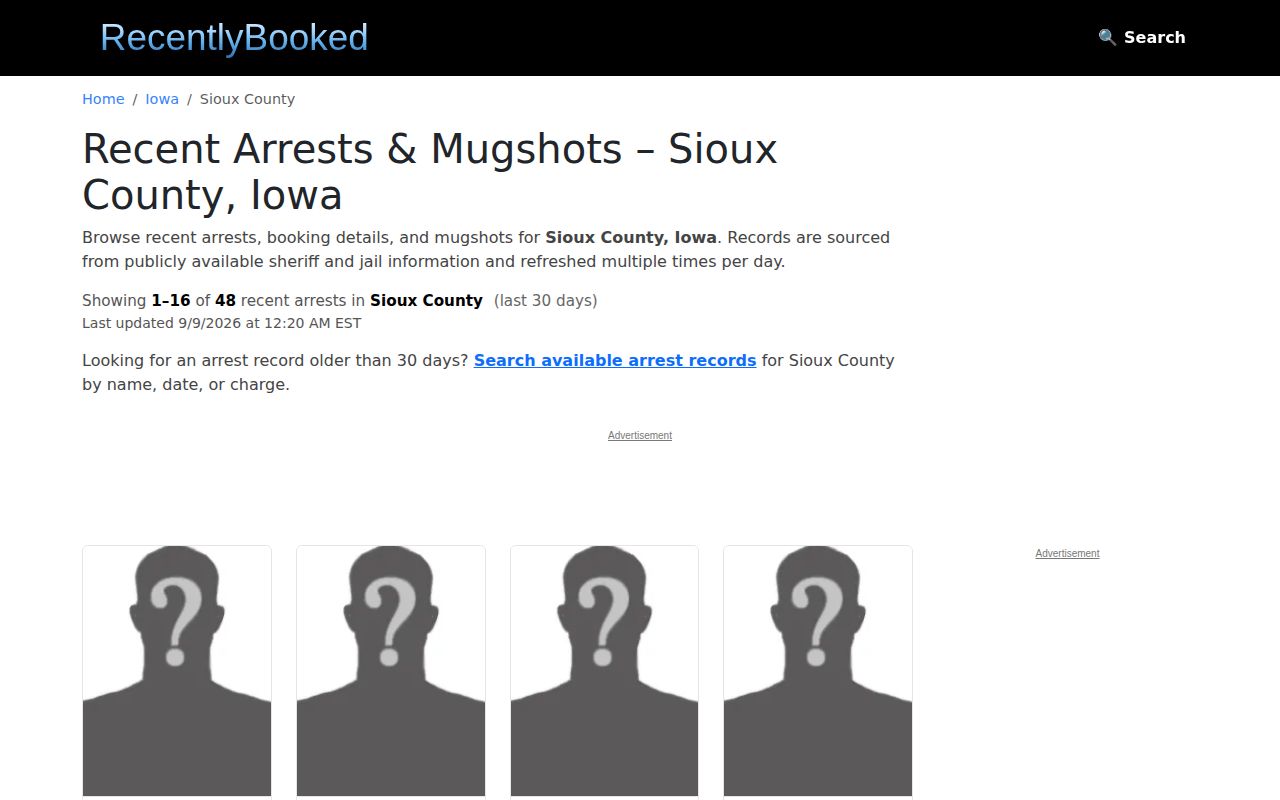
Verify anything against the Sheriff log and court record. Ask the original record holder or publisher to correct an error.